
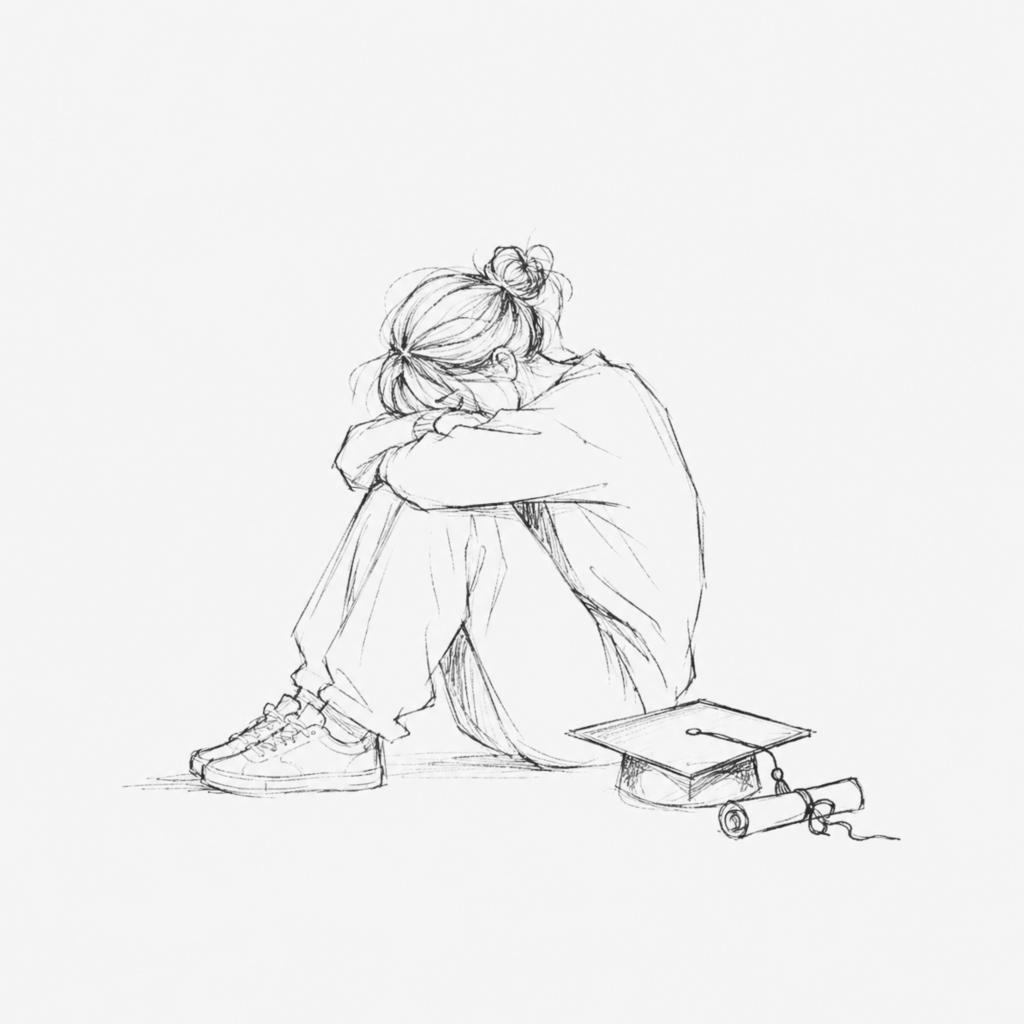
Higher education & eating disorders – what needs to change?
Universities aren’t a treatment service and it’s not their job to stop someone becoming unwell. But they are uniquely positioned for prevention, early intervention and supporting recovery – and they have a duty of care, and a responsibility to make staying well possible: to create a culture that isn’t complicit with societal narratives of diet, exercise and body image, and an environment that doesn’t facilitate an eating disorder thriving unchecked.
Many UK students will have grown up in schools where they were weighed at age four and eleven under the National Child Measurement Programme, subject to clean plate policies in the canteen, and taught to see certain foods and bodies as either good or bad. They’ve been conditioned for years before they even arrive, then spent secondary education in the grip of social media, peer comparison and pressure to achieve. Then they reach university – often the point where they’re forging their own path for the first time, with newfound independence and the freedom to figure out who they really are and who they want to become, without strict parental or institutional oversight. That transition is itself a risk factor. Couple it with an illness that feeds on isolation, and becomes an identity anchor at the very age identity is forming. The influence of the university environment is huge. The often unconscious choices universities make in the everyday design and operation of their services serve to reinforce or to disrupt a disordered mindset – validating the same messaging an eating disorder feeds on, or offering not just permission to recover but an open invitation to do so. Recovery means going against the very things society rewards, and that’s excruciatingly difficult. A university can’t do the recovering for someone – but it can cultivate the conditions that make pro-recovery choices more accessible. For a student already struggling, that’s an intervention in itself; for one who’s vulnerable, it’s part of prevention. And it only takes one or two people doing things differently to create a ripple effect across students and staff alike.
I’m a former national-level swimmer, and during my undergrad I lived in a house of girls on the team. One housemate moved in with a scale, which got put in the shared bathroom – something I’d never had growing up. Another would portion her meals with cup measurements, and the third would rarely have breakfast before we trained. If you’d asked anyone which of the four of us was most at risk of developing an eating disorder, I’d have been last on the list. I had the healthiest relationship with food. I never weighed myself. I never calorie-counted. I’d have dessert after breakfast, chocolate at any hour, and no foods were off limits. Yes, I was an athlete, but I was also a ravenous 20-year-old who was always on the go, and – most importantly – was happy and healthy. What my uni days quickly showed me is that nobody is immune. And that while my environment was not the sole cause of my illness, it absolutely defined the conditions in which it totally took control.
I went from vaguely conscious of nutritional information at on-campus cafés to hyper-fixated on the numbers on every menu display. I religiously obliged the signs in the library that challenged me to take the stairs to the 8th floor to get my steps in on a sedentary study day. The full-length mirrors plastered on every wall of the locker room, and the industrial-sized scale positioned right at the entrance, suddenly became glowing beacons of self-criticism. The nutrition lecture spotlighting intermittent fasting as a universal good, and the joking comment about my Cadbury supply from a peer who “couldn’t possibly” – I took to heart.
I ran with the praise of initial changes, pouring everything I had into training and solitary 10-hour library days, declining all social invites and protecting my routine at all costs. It was seen as the profile of a dedicated student athlete – a product of the rigorous, competitive environment I was in – until it became the undoing of me.
And I can’t help but wonder how things might have been different had the spaces I was in, and the people around me, had a curiosity that looked beneath the surface – and that dared to question the narratives and norms, and encouraged room for neutrality.
I often work at the library at UWL, and every time I do the messaging there catches my eye. Posters encouraging rest, balance and self-care – to say yes to a weekend coffee with friends, to grab something yummy from the bakery; to consider taking the stairs for the benefits to mood, the environment, and heart health, rather than for burning energy or losing weight. It’s a great example of an environment that interrupts an eating disorder rather than feeds it. And it’s also a kindness – gentle, holistic messaging – that stands out precisely because it’s not the norm. I think there’s something telling in the fact that this feels out of place.
True change is a whole university ethos that is caringly inquisitive – asking why things are the way they are, and what “different” could look like. It’s not a tickbox policy or a single intervention that relies on one individual or team. It’s creating the space for, and the willingness to start, conversations among staff and students alike – building a culture that’s ED-informed in its decision-making, design, language, and attitudes.
If HEIs act as extensions of the wider social and cultural landscape, they risk overlooking – or worse, encouraging – those who appear to be coping but are actually closest to falling apart. Universities have the potential to exacerbate and accommodate an eating disorder, or to grow and nurture the person beneath. That’s both a powerful and a privileged position to be in – and one that cannot be underestimated in its impact.
 Things I think.
Leave a comment